Demand-controlled indoor climate for smarter buildings
By measuring occupancy, temperature and air quality, the ventilation is automatically adjusted to actual demand, room by room. This creates a pleasant indoor climate with high comfort and efficient energy use.
What sets Lindinvent apart is the complete solution: draught-free and quiet air distribution across a wide operating range, intelligence in every room and simple central administration.

How Lindinvent’s indoor climate system works
A good indoor climate should go unnoticed by occupants, while the building uses no more energy than necessary. This is how our system works.
An indoor climate that goes unnoticed
Draughts and noise are the most common causes of ventilation complaints. When airflow varies according to demand, air distribution must work equally well at both low and high flow rates.
- Draught-free across a wide airflow range – the self-regulating slot opening maintains discharge velocity and air mixing even at low flow rates.
- Low noise level – the diffusers remain quiet throughout their entire operating range. See the sound data in the data sheets.
- The right climate in every room – airflow, heating and cooling are controlled according to the room’s current needs.
Ventilate where it makes a difference
The best energy saving is the energy that is not needed. By controlling each room individually and coordinating heating and cooling, resources are used where and when they make a difference.
- Ventilation only when and where it is needed – airflow is controlled according to occupancy, temperature and air quality.
- Less preheating and more free cooling – cool supply air can be used without draughts thanks to effective air mixing in the diffuser.
- Heating and cooling work together – sequence control reduces the risk of the systems working against each other.
Norregårdskolan in Växjö after refurbishment, including demand-controlled ventilation.
Easy to build and adapt
The more separate components there are, the more interfaces must be designed, installed and maintained. By integrating the functions into the active diffuser, both new construction and future adaptations become simpler.
- Fewer components to install – controller, damper and sensors are integrated into the active diffuser.
- Easy to design – a wide operating range means that a small number of diffuser sizes can cover many rooms and airflow requirements.
- Easy adaptation to changing needs – setpoints and functions can often be changed through configuration, locally or centrally via LINDINSPECT®.
Demand control – occupancy, CO₂ and temperature
The sensors in the diffuser detect how the room is used. Ventilation increases as occupancy rises and decreases when the room is empty.
Occupancy control
Why ventilate an empty room in the same way as a room full of people? With occupancy control, the system detects whether anyone is in the room and adjusts the ventilation accordingly.
When a room is empty, ventilation can be reduced to a lower airflow. When someone enters, the occupancy sensor detects the change and the system adjusts ventilation to the room’s needs.
Occupancy control kan kombineras med mätning av exempelvis CO₂ och temperatur för en mer exakt reglering.
CO₂ control
People emit carbon dioxide, CO₂, when we breathe. In rooms occupied by many people, CO₂ levels can therefore rise quickly if ventilation is not adapted to occupancy.
A CO₂ sensor continuously measures the concentration. When the CO₂ level rises, the system can automatically increase airflow, and when the level falls, airflow can be reduced again.
CO₂ control är särskilt användbart i lokaler där personbelastningen varierar mycket, exempelvis mötesrum, konferenslokaler och klassrum. Luftflödet kan då anpassas efter den parameter som för tillfället kräver mest ventilation.
Temperature control
Temperature has a major impact on how we experience the indoor climate. At the same time, room temperature is affected by many factors, such as the number of people, electronic equipment, and heating or cooling from the building systems.
By continuously measuring room temperature, the system can adjust ventilation, heating and cooling according to current demand.
Temperature control kan kombineras med närvaro- och CO₂-mätning för en mer exakt och energieffektiv reglering.
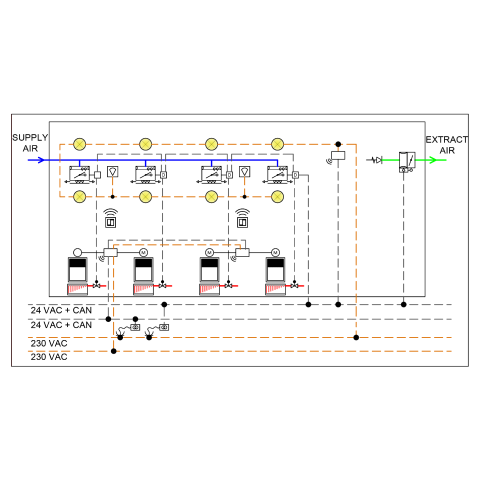
One system for the entire room
The indoor climate is at the heart of Lindinvent’s system. The same occupancy and temperature data that controls ventilation can also control lighting and solar shading, on the same communication loop.
- Fewer separate sensors and systems in the room.
- Solar shading can allow solar heat into the room when heating is needed.
- The lighting can be switched off when the diffuser detects that the room is empty.
Overview in LINDINSPECT®
Temperature, CO₂, occupancy and airflow data are collected in a web interface – for the entire building, down to room level.
- Monitor the indoor climate in real time on a floor plan.
- Analyse historical data to investigate complaints and deviations.
- Change setpoints and functions centrally when operational needs change.

With you from design to operation
Lindinvent supports you at every stage and normally commissions its own products. Contact us early in the project.
1. Design
System solution, sizing and design guidelines.
2. Installation
Diffusers and the loop are installed by the contractor.
3. Commissioning
The system is configured and commissioned.
4. Follow-up
Operation and indoor climate are monitored in LINDINSPECT®.
Indoor climate in different types of buildings
Offices
In offices, ventilation demand varies throughout the day. With demand-controlled indoor climate, ventilation, heating and cooling are automatically adjusted according to occupancy, temperature and air quality.
Schools
In schools, occupancy can change quickly. By adjusting ventilation according to occupancy, temperature and CO₂ levels, each room receives the right amount of air based on current demand.
Hospitals & Healthcare
With demand control, airflow and temperature can be adjusted according to room use and current demand, providing a stable and comfortable indoor climate.
Laboratories
Laboratories often have high and specific requirements for ventilation, airflow and pressure conditions. Continuous monitoring and control provide the right conditions.
In-depth: indoor climate and ventilation principles
For those who want to learn more about what affects the indoor climate.
What is a good indoor climate?
A good indoor climate is crucial to how we feel, thrive and perform indoors. Air quality, temperature, airflow and ventilation noise are some of the factors that affect how we experience a room.
At the same time, demand changes depending on how many people are present and how the room is used. Understanding and measuring these factors creates the conditions for an indoor climate that adapts to the people in the room.
CAV, VAV and DCV – the difference
CAV Constant Air Volume
CAV supplies a constant airflow regardless of how many people are in the room or the actual demand. The principle is simple, but it means that a room may receive the same airflow when empty as when occupied.
VAV Variable Air Volume
VAV allows the airflow to vary instead of remaining constant. The airflow is regulated between different levels depending on the system design and the control signals used.
DCV Demand Controlled Ventilation
DCV, or demand-controlled ventilation, uses variable airflow to adapt ventilation to actual demand. The airflow can, for example, be controlled based on temperature, occupancy or the CO₂ level in the room.
Air quality, draughts and noise
Good air quality means that the air we breathe indoors should be fresh and comfortable. People, building materials, furnishings and different activities affect air quality and the need for ventilation. When many people occupy the same room, the concentration of carbon dioxide, CO₂, increases and can be used as an indicator of how well ventilation matches the room load.
By measuring CO₂ and occupancy, among other factors, ventilation can be adapted to current demand. Airflow can increase when more people are in the room and decrease when the room is empty or lightly occupied. This maintains good air quality without ventilating more than necessary.
The correct airflow is essential for a good indoor climate. Too little air can lead to poorer air quality, while excessive or poorly distributed airflow can cause draughts and discomfort.
It is therefore not only about how much air is supplied, but also how it is distributed in the room. Supply air must reach the occupied zone in a way that creates an even and comfortable indoor environment without disruptive air movements.
With demand-controlled ventilation, airflow can be continuously adapted to the room load. When demand changes, the airflow is regulated to create the right conditions for both air quality and comfort.
Ventilation should contribute to a good indoor climate without disturbing the people in the room. Fans, airflow, duct systems and diffusers can generate noise that affects perceived comfort and the working environment.
A well-designed ventilation solution must therefore consider both airflow and sound levels. This is particularly important in environments where people need to concentrate, communicate or rest, such as offices, schools and healthcare facilities.
By sizing and controlling airflow according to actual demand, ventilation can contribute to a comfortable indoor climate without unnecessarily high airflow or disruptive noise.
How the indoor climate affects people
We spend a large part of our time indoors, making the indoor climate an important part of everyday life. Air quality, temperature, draughts and noise affect how we experience a room and can influence well-being and comfort as well as concentration and performance.
A good indoor climate is ultimately about people. Different rooms are used in different ways, and occupancy can change quickly during the day. A meeting room, for example, may be empty one moment and full of people the next.
By allowing the indoor climate to follow the room’s actual use, the right conditions can be created when needed. Demand control makes it possible to combine people’s need for a good indoor climate with efficient use of the building’s energy.
Indoor climate in practice
Modernisation & reuse
Greenhouse Solna Strand
At Greenhouse Solna Strand, an existing indoor climate system was modernised by upgrading 980 chilled beams instead of replacing them. Demand control, sensors and digital monitoring make it possible to monitor and optimise the indoor climate, energy use and space utilisation.
Skola & energi
Norregårdskolan in Växjö
When Norregårdskolan was renovated, the building received a new demand-controlled ventilation system, among other improvements. After the renovation, energy use decreased from 190 to 54 kWh/m² per year, while ventilation is adjusted to the school’s actual needs.
Kontor & komfort
Atrium Ljungberg
At Atrium Ljungberg’s offices, demand-controlled ventilation creates a quiet, draught-free indoor climate in a flexible working environment. Airflow and temperature are adjusted according to demand and can be controlled at room level.
Planning indoor climate control for a project?
We support you from design and needs analysis to control, commissioning and follow-up. Contact us early in the project so we can review the building’s and organisation’s requirements together.